Window price estimator.

Describe your project in three minutes. You see your price range and the Rénoclimat grant you could be entitled to. We then come back with up to 5 compared quotes. Free, at your own pace.

§ 01 · How to measure

Five minutes of measuring, and your price gets accurate

A quote is only as good as your measurements. Five minutes here saves a round trip and gives you prices you can actually compare.

  1. Measure the opening, not the window

    Forget the current window. What matters is the hole in the wall. Measure the width inside the frame, wall to wall, in three places: top, middle and bottom.

  2. Keep the smallest measurement

    Of the three widths, keep the smallest. Do the same for the height, on the left, in the centre and on the right. A house shifts over the years, an opening is rarely perfectly square.

  3. Note the frame depth

    Between 7 ¼ and 10 ¼ inches is the standard, and most prices are based on it. Outside that range it is doable, but it is quoted separately.

  4. Work in inches, to the nearest ⅛

    Half an inch changes the quote. If you hesitate between two measurements, write down both and tell us.

  5. Take a photo of each opening

    From the inside, standing back far enough to see the whole frame. A photo is worth a paragraph: it shows the opening type, the state of the frame and condensation between panes.

§ 02 · What drives the price

Why two quotes can differ by double

Here is what really moves a window price, so you can compare your quotes yourself.

The number of openings

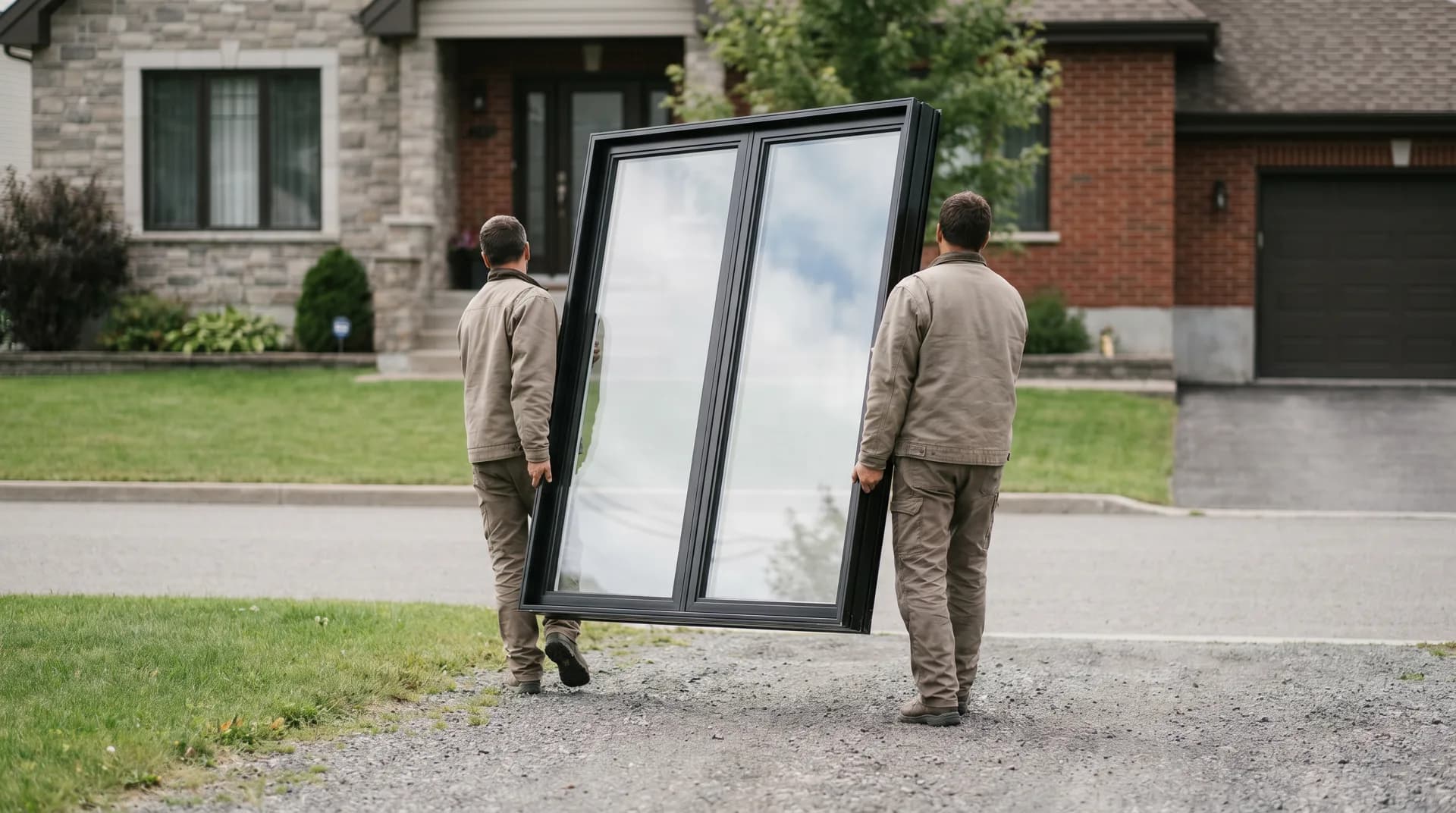
An opening is a hole in the wall, not a pane of glass. A two-panel window in a single frame is still one opening. That count is what drives the grant calculation.

The opening type

A casement costs more than a fixed window of the same size because it carries hardware. A slider sits between the two. The gap matters in a real quote, but it is not enough to move a range: the material does that job.

The material

PVC is the most common and the least expensive. Hybrid puts aluminum outside, where it takes the rain, and PVC inside, where it insulates. A frame in any colour other than white often means going hybrid. Triple glazing adds a bit to the price.

Doors

An entry door, a patio door and a garage door are not quoted the same way. Glazed side sections or a transom above a door depend on the door: they are quoted on site.

The bay window

A bay projects out from the wall and forms a nook inside. It needs a structure and sometimes a small roof, so it does not compare to a flat window of the same width.

The upper floor

A high opening needs scaffolding or a lift. That is time and equipment, and it shows in the price.

§ 03 · The grant

Rénoclimat, what you can go and get

The amount and the conditions

The Rénoclimat program pays $150 per opening replaced with an ENERGY STAR certified model (source: quebec.ca). The questionnaire calculates the possible amount as you describe your project.

Three conditions to know before counting on that amount. An energy assessment must be done before the work. The installed products must be certified. And you are the one who registers and signs. We coordinate your file from A to Z, you do not have to chase the program.

A range, not a quote

The questionnaire gives you a ballpark, from the low end to the high end. It is a benchmark for shopping around, not a firm price: Renoconnect installs nothing and sells no product. The real number comes from carefully selected partner companies, and we come back to you with up to 5 quotes, compared with you. Free for you: the selected company covers our fee, never the homeowner.

§ 04 · Your estimate

Describe your project, we give you the range

Three minutes, one question at a time. Fill in what you know: empty fields block nothing, an advisor calls you back to complete it. Free, no commitment, on Montreal’s North Shore.

Step 1 of 5

Your openings

Your openings

We start with the count. It drives everything else, including your grant.

Count openings, not glass panels.

Entry, patio and garage.

A bay projects out from the wall and forms a nook. It is quoted on site.

An opening is a hole in the wall. Two sashes in the same frame count as one.

Enter at least one window, door or bay to continue.

Frequently asked questions

We answer your questions

Yes, a range. It appears as soon as you send your contact details, because a price with no advisor to explain it is worth nothing. It is not a quote: Renoconnect is an advisor, it installs nothing and sells no product. We send your project to carefully selected partner companies, and you receive up to 5 real quotes compared with you.

Expect roughly $1,600 to $2,000 per opening in PVC, and $1,900 to $2,450 in hybrid, installation included, before taxes. An entry door runs $2,250 to $3,500, a sliding patio door $2,900 to $3,400. Side panels, bay windows and garage doors are quoted on site. These are Renoconnect ballparks for 2026, not guaranteed prices: the material is what moves them the most.

One. An opening is a hole in the wall, not a pane of glass. Two panels in the same frame are still one opening, and that count is what drives the grant calculation.

Measure the opening, not the current window. Take the width inside the frame at the top, middle and bottom, then keep the smallest of the three. Do the same for the height on the left, centre and right. Work in inches, to the nearest ⅛.

The program pays $150 per opening replaced with an ENERGY STAR certified model (source: quebec.ca). An energy assessment must be done before the work, and the homeowner is the one who registers and signs. Renoconnect coordinates the file from A to Z.

No. It is free for the homeowner. The selected company covers our fee, never the homeowner.

You have your range. We handle the rest.

We send your project to carefully selected partner companies and compare the quotes with you. Free for the homeowner.

Call