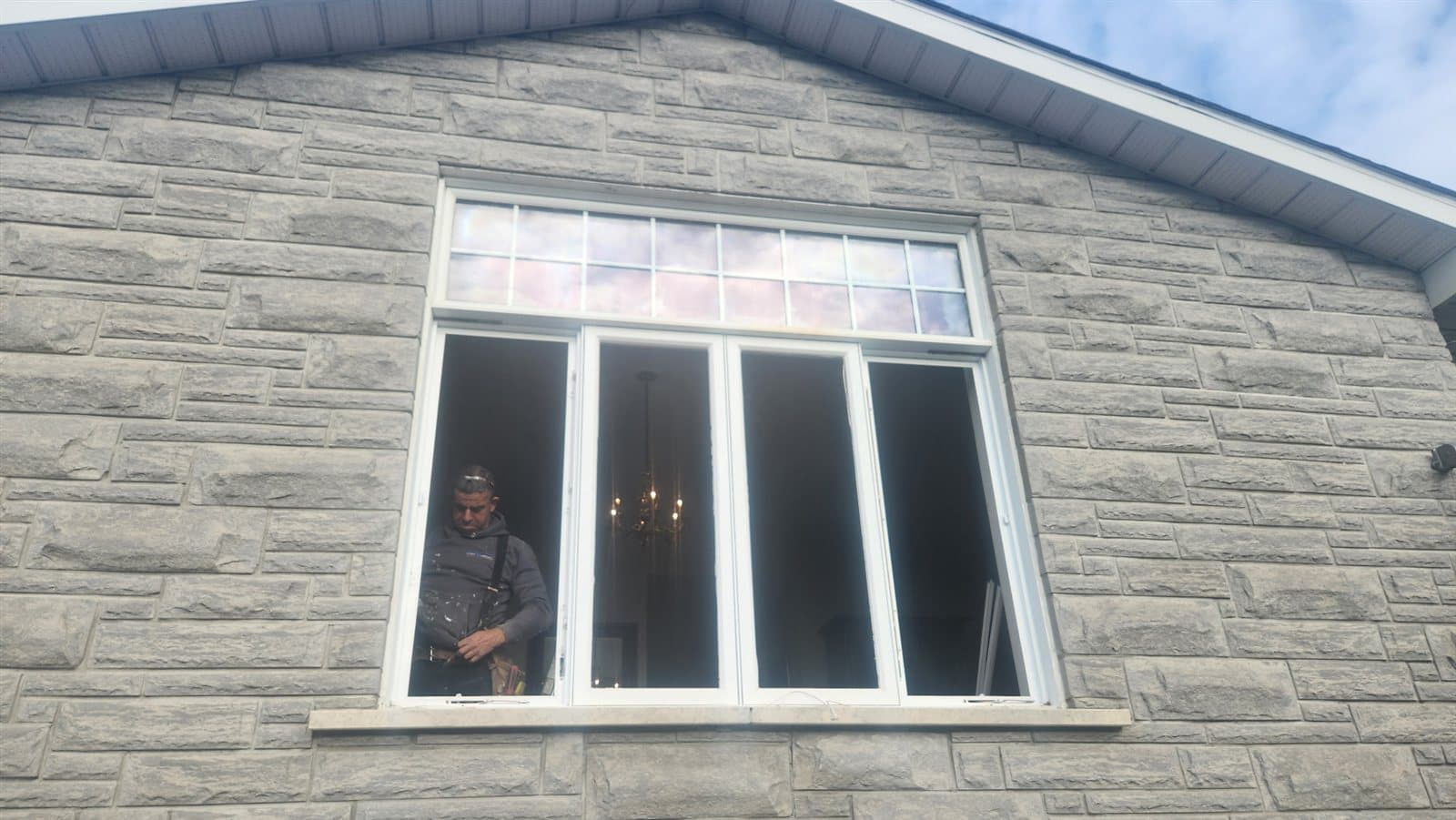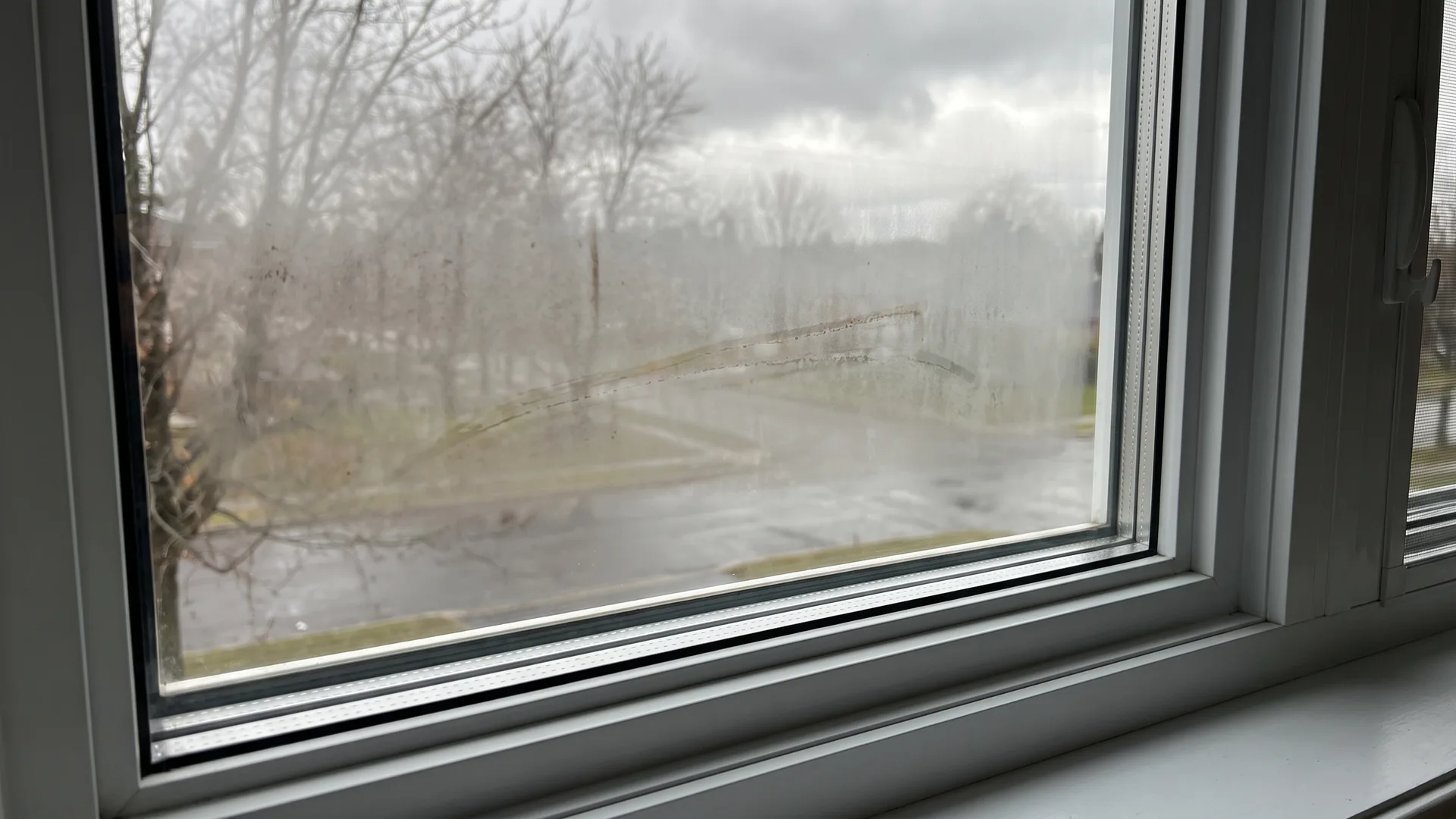
One morning you notice a white haze between the two panes in the living room. You clean the window from the inside. Nothing. You go outside and clean it there too. Still nothing. That’s normal: the fog is neither inside nor outside, it’s trapped in the middle of the glass.
From there, only one question matters, and it’s worth several hundred dollars: do you change the glass unit alone, or the whole window? The answer depends on the state of the frame, the age of the window, your warranty, and one detail almost nobody puts on the table: the grant money you give up by repairing. Here is how to decide.
Where the fog between the panes comes from
A modern window isn’t just two sheets of glass. It’s a sealed unit: two or three panes separated by a spacer, with the space filled with an inert gas, often argon or krypton, to reduce heat transfer through the glass (Natural Resources Canada). The whole thing is sealed at the factory.
When the seal fails, humid air gets into that space. Écohabitation puts it plainly: condensation between the panes generally points to a problem with the seal. The fog you see is that moisture settling on the cold face of the glass, inside the unit. You can’t reach it. You’re on both sides of the sandwich and it’s in the middle.
That seal doesn’t fail at random. It ages with every heat and cold cycle, and our 30 degree summers followed by minus 25 in January speed things up. In the field, the south and west facing windows usually go first, the ones taking the most sun.
What it costs you, even when the window looks fine
A failed sealed unit isn’t just a cosmetic issue. The insulating gas is gone, the space between the panes no longer does its job, and the window lets heat out all winter. You pay for it every month without ever seeing it on a line of your bill.
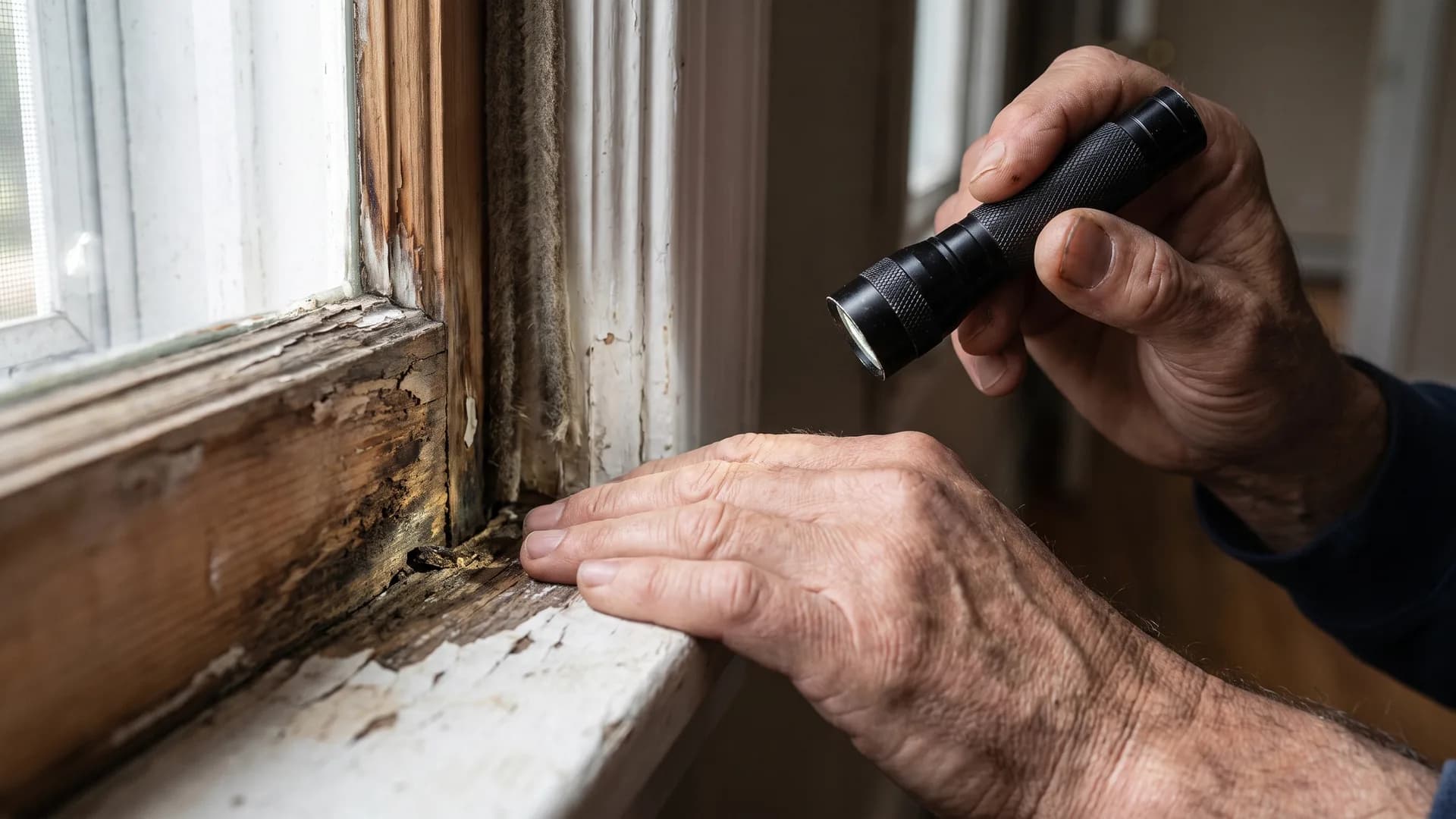
There’s worse than the heating bill. The water that builds up eventually attacks the frame. Écohabitation is clear on this: on a wood frame it will cause rot, and a PVC frame can crack, which lets even more water collect. Fog ignored for two or three winters can turn a simple glass replacement into a full window replacement.
It’s the same logic as in our guide to the signs of a window at the end of its life: the longer you wait, the more the cheaper option disappears on its own.
Replacing the glass unit alone: when it’s a real option
Yes, the sealed unit can be replaced without touching the frame. It’s the right call when the window is still relatively young, the frame is sound and few openings are affected. A glazier takes the measurements, orders the custom glass and fits it into the existing sash.
Five conditions to check before going that route:
- The frame shows no rot, no cracking and no warping.
- The window opens, closes and locks normally.
- The weatherstripping is still supple, not hardened or crushed.
- The window is less than about fifteen years old.
- One or two openings are affected, not half the house.
If all five hold, the glass alone makes sense. If two or three fail, you risk paying twice: the glass this year, the window three years from now.
Does defogging actually work?
Some companies offer defogging. Two small holes are drilled in the glass, the space between the panes is dried out, and a vent is fitted. The haze goes away, often for good. The question isn’t whether it works, it’s what it actually fixes.
It fixes the look. It does not restore the sealed unit. Vented glass cannot hold an insulating gas, by definition: the space now communicates with outside air. You get the view back, not the original performance.
When it holds up: a sale planned in the coming months, a frame still in good shape, or an opening so hard to reach that replacement costs balloon on scaffolding alone. When it doesn’t: a large living room window, where performance is exactly what you are missing in January. And like the glass unit on its own, defogged glass is not a replacement: no Rénoclimat money for that opening.
The detail that changes the math: the grant
Here is what’s almost always missing from the comparison. Rénoclimat grants $150 per rough opening for replacing an ENERGY STAR certified door or window. But the program is explicit: replacing only the glass, the window sash, or a door without its frame does not qualify for financial assistance (quebec.ca).
Translation: by changing the glass unit alone, you step out of the program for that opening. On a single window, that doesn’t flip the decision. On six fogged openings in the same house, the gap changes nature, and you end up with new glass in old frames instead of six new windows.
The rest of the rules, the energy evaluation before the work, the ENERGY STAR labels to keep and stacking with LogisVert, we covered in our Rénoclimat grant guide. And no, nobody can guarantee you an amount up front: the program advisor is the one who validates your file.
Four questions to settle it
- How old is the window? Under 15 years, the glass alone holds up well. Past 20 years, the rest of the window is close behind.
- How many openings are affected? Just one, you repair. Several in a short span, and the whole batch installed the same year is reaching the end of its life.
- Is the frame sound? That’s the deciding point. New glass in a rotten frame doesn’t last, no matter what you paid.
- Are you staying in the house? Five years or more and a full replacement pays back in comfort and heating. A sale planned for next year and the glass alone does the job.
A plex is not the same decision six times over
On a duplex or a triplex, the math changes scale. Rénoclimat counts per rough opening, not per building: eighteen openings replaced count eighteen times. The program accepts duplexes, triplexes and small multi-unit buildings of three storeys or less, up to 600 square metres of ground area (quebec.ca).
That single fact moves the line between repair and replace. On a house with one fogged window, the glass alone often wins. On a plex where six sealed units fail in two years, repairing one at a time costs a fortune in trips and leaves the rest of the stock aging with nothing solved.
There is one factor owners forget: the tenant. Every intervention means a notice, an access, a day of disruption. Grouping replacements into one job is often worth more than the savings on a single glass unit.
Check the warranty before you pay anything
Plenty of homeowners pay for a glass unit that was still covered. On a window installed by a company, the sealed unit often carries a warranty separate from the frame and the installation.
Where to look: between the two panes, on the metal spacer, there is often a permanent mark. Natural Resources Canada explains that it shows the insulating glass unit passed the durability test. That mark, the manufacturer’s name and your original invoice are usually enough to open a claim. Worth a phone call before you reach for your card.
What if the fog is on the inside or the outside?
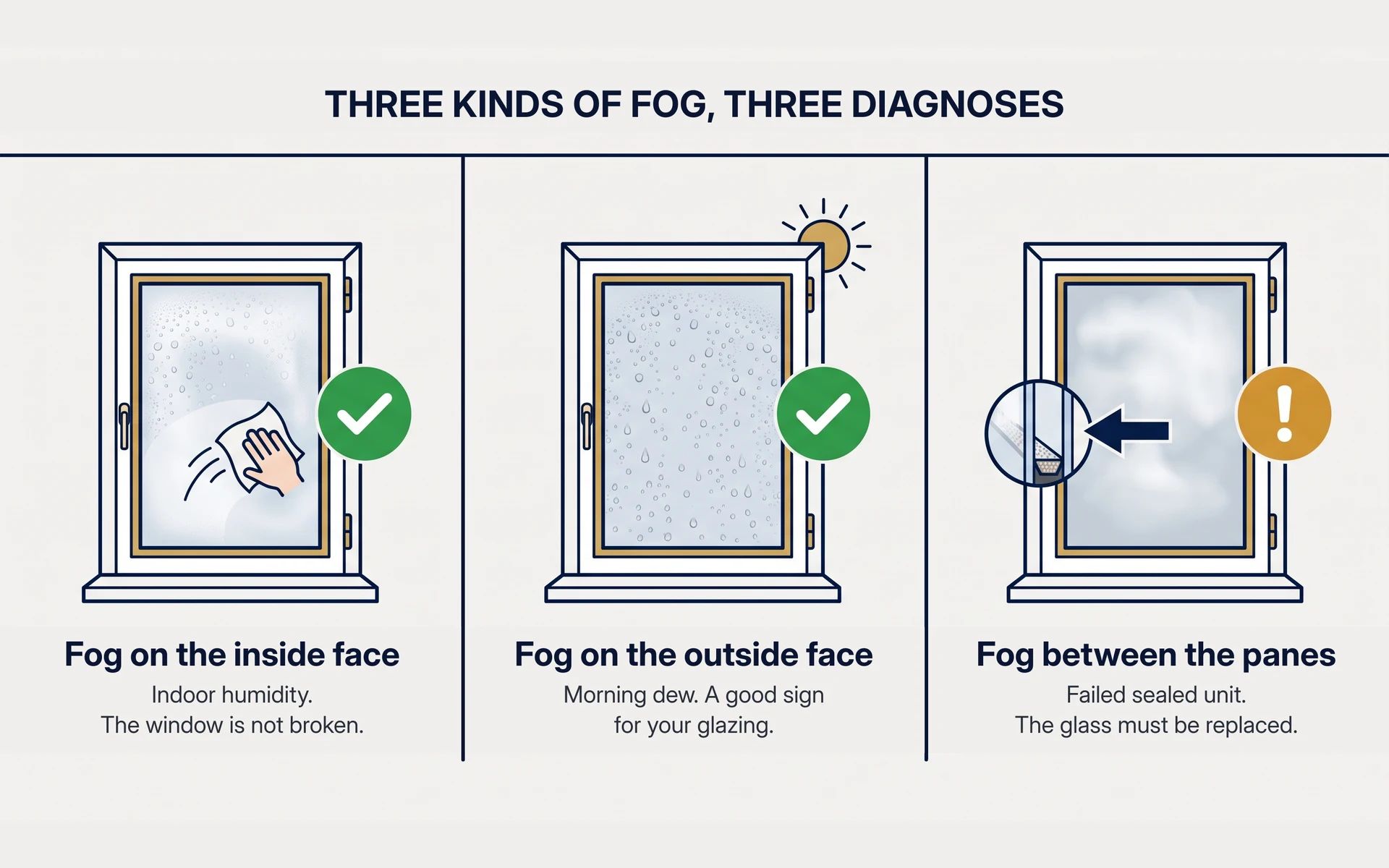
Three kinds of fog, three completely different diagnoses. Only one of them means a broken window.
- Fog on the inside face, in the house: that’s indoor humidity settling on cold glass. The window isn’t broken. We look at ventilation and humidity levels first.
- Fog on the outside face on a mild morning: that’s dew on the glass. It’s actually a good sign, your glazing is keeping the heat inside.
- Fog between the panes, impossible to wipe away: failed sealed unit. That’s the only one of the three that calls for work on the window.
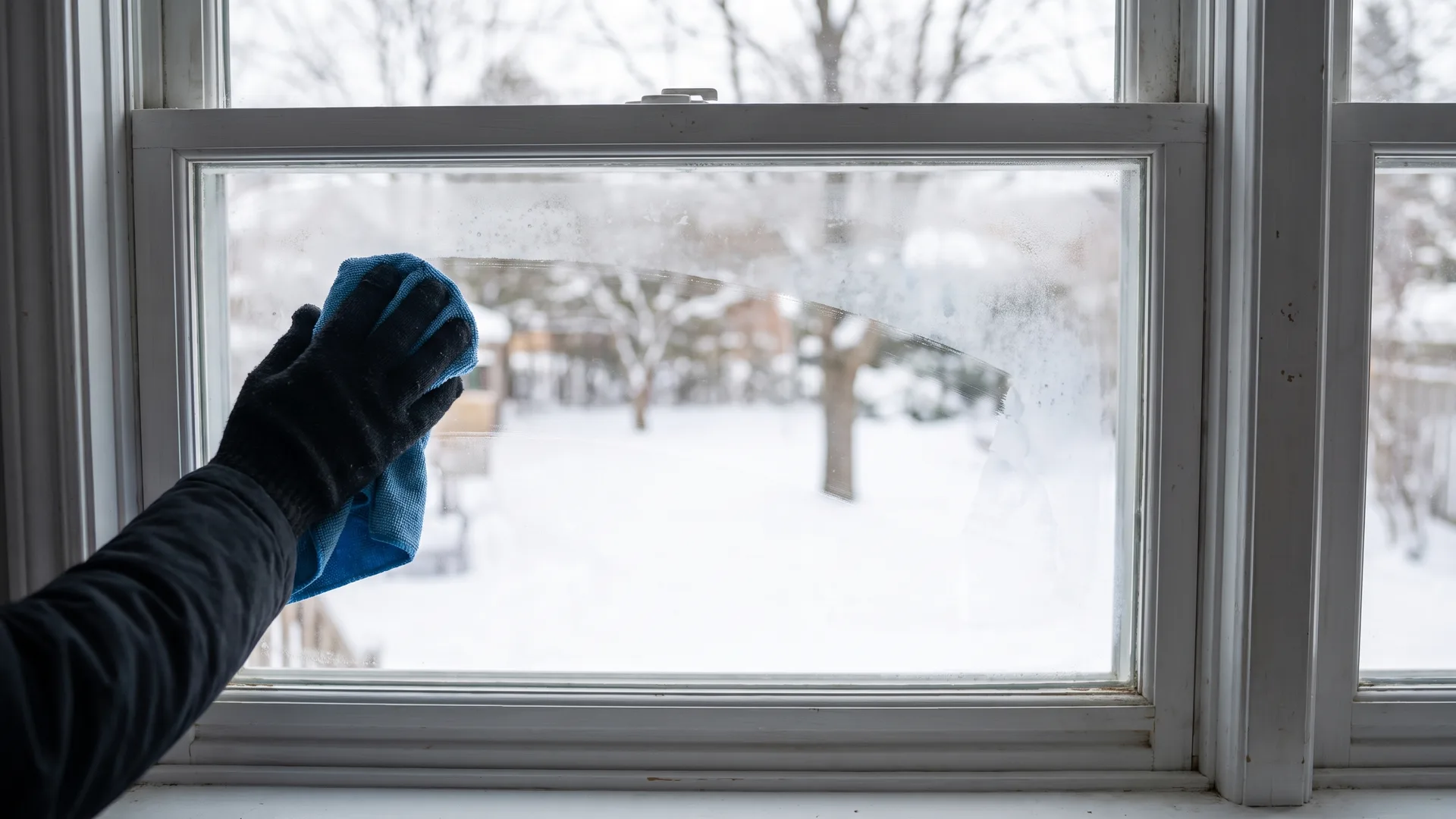
The test takes ten seconds: wipe both faces. If the haze stays, it’s in the middle, and now you know what to do about it.
Patio doors and skylights: same problem
A patio door is a large sealed unit standing upright. A skylight is the same thing lying almost flat. Both lose their seal exactly like a window, and the skylight usually goes first: direct sun all day, melting snow and the freeze that follows.
On the grant side, Rénoclimat covers replacing doors, windows and skylights, at $150 per rough opening, with the same ENERGY STAR requirement (quebec.ca). And the same exclusion: replacing the glass alone does not count, whatever the type of opening.
The difference is in the job. A skylight touches the roof, so the membrane and the flashing. We never treat it like a living room window. It is one of the rare cases where waiting for the next roofing work and doing it all at once is worth it.
Why the haze always starts at the edge
Look at a fogged window: the haze almost always starts at the edge, never in the middle. That is no accident. The perimeter is the weakest part of the unit, because that is where the spacer sits, the piece that separates the two panes and carries the seal.
An aluminum spacer conducts cold from one pane to the other. The inner surface stays colder along that edge, moisture settles there first, and the seal works harder. A warm edge spacer, made of a less conductive material, reduces that thermal bridge.
That is why the spacer is on the list below. Two glass units at the same price, one with a warm edge and one without, will not age the same way. You will see the difference in eight years, and by then the quote will be long gone.
What we look at in a glass unit quote
A glass quote is as hard to compare as a window quote. The spread on the same opening is wide, and what explains it is rarely written in large print. Five things to ask about before signing:
- The glass being proposed: double or triple, with or without a low-emissivity coating, with or without argon. Not the same product, not the same price.
- The spacer: a warm edge model limits condensation around the perimeter, exactly where the problem starts again.
- The warranty on the new unit, in writing, with its length.
- The real lead time: custom glass is ordered, count a few weeks.
- What happens if the frame turns out to be damaged once the glass is out. That clause saves you the mid-job surprise.
We go through that with you, line by line, without selling a product.
Where to start
Start by counting. Walk the house, note the fogged openings, wipe both faces to confirm, then look at the state of each frame. That small inventory is worth more than any estimate given over the phone.
Then compare the two scenarios for real: the glass unit now, or replacing the affected openings with the grant. We run that math every week, and it doesn’t always land on the same side. When the glass alone wins, we tell you. We sell neither windows nor glass, which leaves us free to give it to you straight. Our full approach is laid out on our windows and doors page.
Frequently asked questions
Not in the sense of drying the window out. The sealed unit gets replaced, with or without the frame. Glass that has been drilled and vented can clear the fog, but it no longer holds the insulating gas: the original performance doesn’t come back.
No. The program excludes replacing only the glass, the sash, or a door without its frame (quebec.ca). The $150 per rough opening applies to replacing the window or the door itself, ENERGY STAR certified.
As long as the frame stays sound there is no structural emergency, but you lose heat every winter month. The real risk is water eventually attacking the frame: that’s when the bill changes category.
Not necessarily. But windows installed the same year age together. When two or three units fail in a short span, it’s worth looking at the whole batch before repairing one at a time.
The failure is the same, the job is not. A skylight touches the roof membrane and flashing. Rénoclimat covers it like a window, at $150 per rough opening (quebec.ca), but we always check whether roofing work is coming before setting a date.
No, we install nothing and we sell nothing. We assess your situation, gather quotes from partner companies and compare them with you, at your pace.
Often not. Fog around the perimeter, on the inside face, points to a cold spacer and high indoor humidity. We look at ventilation before concluding the seal has failed.