You’re shopping for windows and every company pushes its own material. The one selling PVC talks about insulation. The one selling hybrid talks about looks. The one selling aluminum talks about big openings. All three are partly right, and that’s exactly what makes it confusing.
We don’t sell any of the three. That leaves us free to tell you what each material does well, what it does less well, and which one makes sense for your house. Here is the comparison we walk through with our clients, with sources.
The short answer
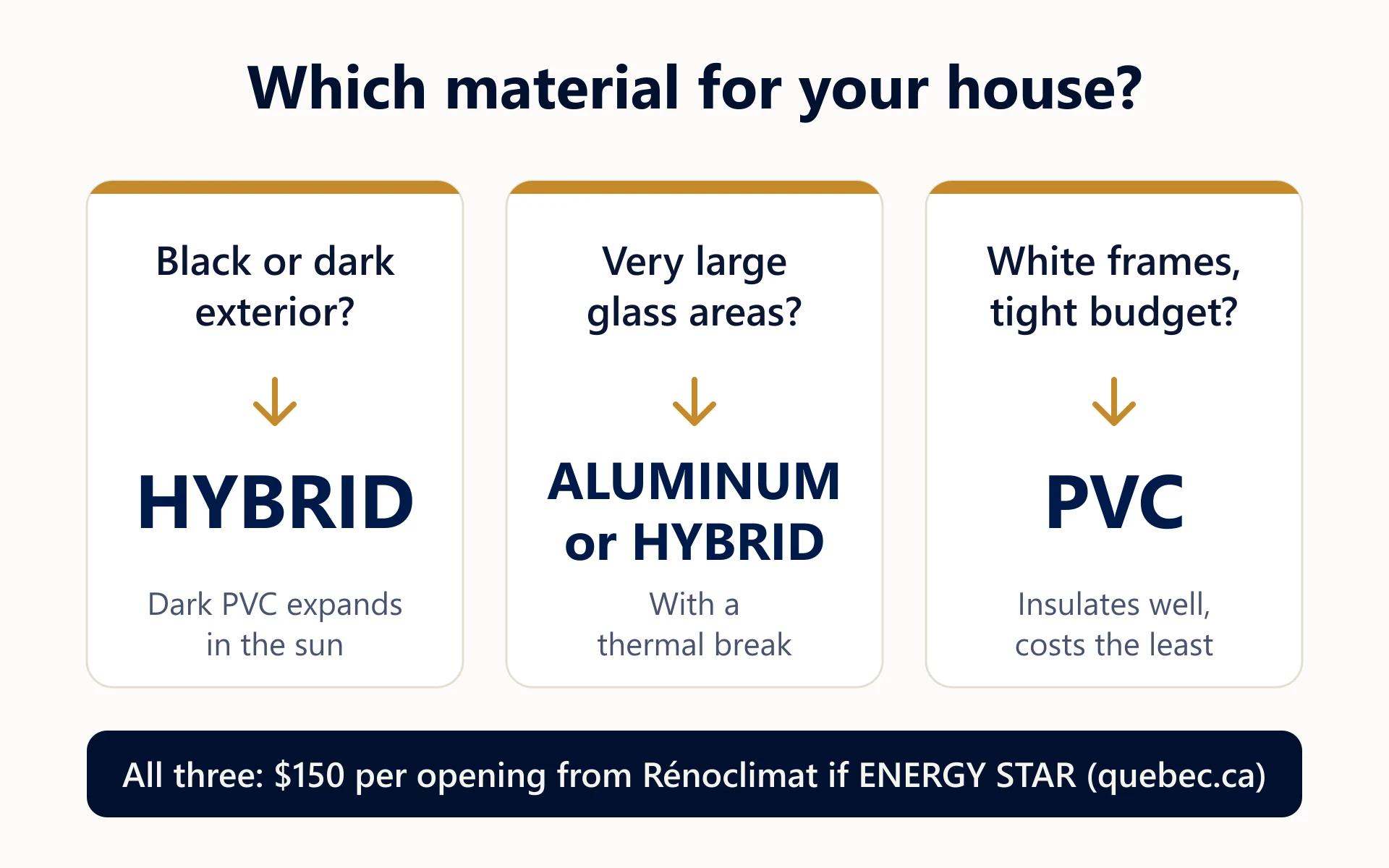
If you just want to know where to start, here is the rule we apply in most files:
- White or light frames, a tight budget or lots of openings: PVC.
- Black or dark frames on the outside: hybrid. We explain why further down, it’s the most important section of this article.
- Very large glass areas, a contemporary look, a budget to match: aluminum with a thermal break, or hybrid.
The rest of the article is the why. And the why is what keeps you from paying for the wrong material.
PVC, hybrid, aluminum: the table
| PVC | Hybrid | Aluminum | |
|---|---|---|---|
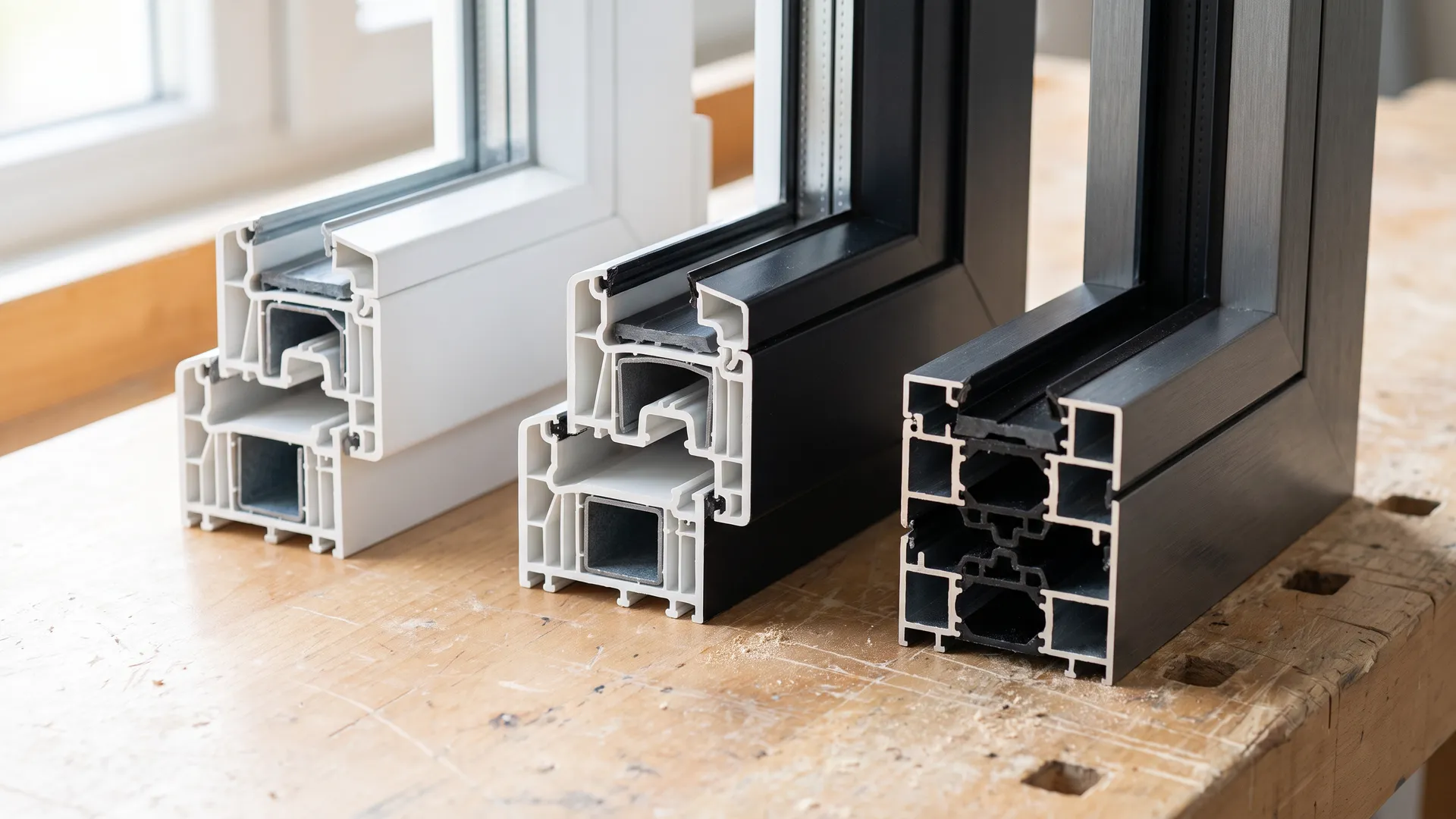
| What it is | PVC frame, inside and out | PVC frame clad in aluminum on the outside | Aluminum frame, with a thermal break on good models |
| Frame insulation | Good: PVC insulates well | Good: the same PVC does the insulating | Poor without a thermal break: metal conducts cold |
| Dark exterior | Watch out: dark PVC expands in the sun | Yes: the aluminum shell takes the heat | Yes |
| Upkeep | Low | Low | Low |
| Large openings | Thicker frames | In between | Slimmest frames, according to manufacturers |
| Cost | Lowest | Higher than PVC | Usually the highest |
| Rénoclimat | $150 per opening if ENERGY STAR | Same | Same |
PVC: the default choice, for good reasons
PVC is what you see on most houses on the North Shore. It resists moisture, insulates well and needs little upkeep (Écohabitation). No paint, no stain. A wipe in the spring and you’re done.
It’s also the cheapest of the three. On a house with fifteen openings, the gap adds up fast, and it’s often what decides.
Its limits are real, though. PVC reacts to heat: in the sun, it expands. In white, that’s not a problem. In black, it’s another story, we’ll get to it. Its frames are also thicker than aluminum, which leaves a bit less glass on very large openings. And on the environmental side, Écohabitation points out that making PVC pollutes and that it recycles poorly.
Aluminum: strong and slim, but it conducts cold
Aluminum is sturdy, needs little upkeep and recycles (Écohabitation). Manufacturers put it forward for large openings and patio doors: its stiffness allows slimmer frames, so more glass.
Its weakness is well known. Aluminum conducts heat better than other materials (Natural Resources Canada). In winter, it carries the cold from outside to inside. Écohabitation puts it plainly: it’s a thermal bridge, and you need to ask for a thermal break to block that conduction. An aluminum window with no thermal break, in a heated Quebec home, is not something we’ll recommend.
There’s also condensation. An aluminum frame gives a colder surface than other materials, so fog forms on it sooner (Écohabitation). A thermal break helps. So does keeping indoor humidity under 40% in winter.
That doesn’t rule it out. Natural Resources Canada notes that a window’s overall efficiency depends more on its design than on the frame material. A well designed, ENERGY STAR certified aluminum window meets the same standard as the others.
Hybrid: PVC inside, aluminum outside
In Quebec, a hybrid window is almost always a PVC frame clad in aluminum on the outside (Écohabitation). The PVC does the insulating. The aluminum is the shell.
What you’re really buying with a hybrid is freedom of colour on the outside. The aluminum shell takes the sun, the PVC stays sheltered behind it, and the frame stays stable. Inside, you keep a white frame that’s easy to match.
What it costs: more than PVC, for comparable frame insulation, since it’s the same PVC doing the work. If you want white everywhere, a hybrid makes you pay for a look you won’t use.
Black PVC windows: read this before you sign
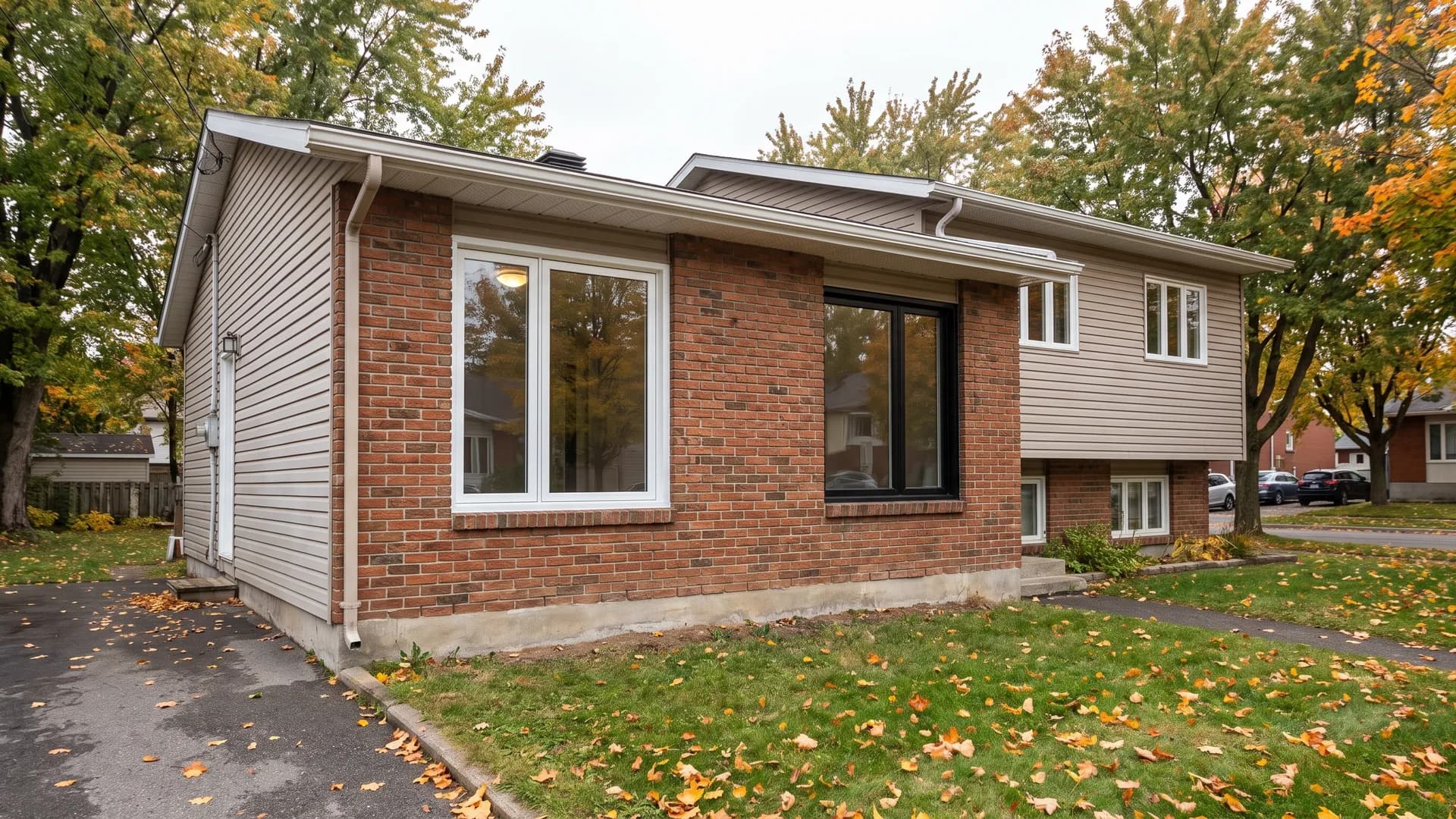
This is where the choice of material becomes more than a matter of taste. Black frames are in style. Black PVC has a documented problem.
A dark frame absorbs the sun’s heat. PVC that heats up expands, which raises the risk of cracks, water leaks, drafts and windows that fall out of alignment (Écohabitation). The same organization reports that poorly fitted black PVC windows are the most frequent claim in Quebec with the Garantie de construction résidentielle (GCR), the province’s new home warranty plan.
That doesn’t mean black PVC is off limits. It means it needs specific installation measures, and you should know whether your quote includes them. For a black exterior, the solution Écohabitation puts forward is a frame clad in aluminum on the outside. In other words, a hybrid.
In practice, about 2 clients out of 10 choose hybrid. Most stay with PVC, often because they keep white frames (Renoconnect files, 2026).
Rénoclimat doesn’t look at the material
Good news for your decision: the grant favours none of the three. Rénoclimat grants $150 per rough opening for replacing a door or window, as long as it’s ENERGY STAR certified (quebec.ca). PVC, hybrid or aluminum, it’s the same amount.
The current ENERGY STAR standard, version 5.0 since 2020, requires a U-factor of at most 1.22 W/m²·K or an energy rating of at least 34 (Natural Resources Canada). Since 2020, there are no more climate zones in Canada: the coldest zone applies everywhere (Écohabitation). If someone still talks to you about “zone 2” or “zone 3”, their paperwork is out of date.
The real trap is elsewhere: keep the ENERGY STAR labels from your new windows, the Rénoclimat advisor will ask for them. All the details are in our Rénoclimat grant guide.
Comparing quotes for different materials
The hard part isn’t picking a material. It’s comparing a PVC quote with a hybrid quote without getting mixed up. Five things to look at:
- ENERGY STAR certification for the exact model, not just the product line. Without it, no Rénoclimat.
- The U-factor or energy rating written on the quote. The lower the U, the better the window insulates (Natural Resources Canada).
- For aluminum: the thermal break, in writing.
- For dark PVC: the installation measures planned for expansion in the sun.
- The glazing: double or triple, with or without argon, with or without a low-e coating. Two quotes with different glazing don’t compare.
On the same house, the gap between two quotes often comes as much from the glazing and the installation as from the frame. That’s why we go through them line by line with you. For a first ballpark based on your material, try our price estimator. For the full price breakdown in Laval, taxes and grant included, read how much window replacement costs.
Four questions to decide
- What colour do you want outside? White or light, PVC. Dark, hybrid.
- How many openings? The more there are, the more the price gap weighs. On a big project, PVC frees up budget for better glazing.
- Do you have very large openings? It’s worth looking at aluminum or hybrid, for slimmer frames.
- Where does the sun hit? A south or west facing wall gets hotter. That’s where a dark colour and the choice of material matter most.
If you’re still torn, that’s normal. We do this exercise with clients every week. We don’t sell PVC, hybrid or aluminum: we compare up to five quotes from partner companies with you, at your pace. To go further on each material: PVC windows, hybrid windows and aluminum windows.
Sources
- Écohabitation, Choosing doors and windows (French)
- Écohabitation, Expansion of dark materials (French)
- Écohabitation, Condensation on windows (French)
- Écohabitation, ENERGY STAR certified windows (French)
- Natural Resources Canada, Condensation
- Natural Resources Canada, ENERGY STAR technical specifications (French)
- quebec.ca, Rénoclimat grant for doors and windows (French)
- Protégez-Vous and Hydro-Québec, Fais ton max: windows (French), infographic, retrieved October 1, 2026
Frequently asked questions
A hybrid’s frame is PVC, just like a PVC window, but it’s clad in aluminum on the outside (Écohabitation). Frame insulation is comparable. A hybrid mainly lets you have a dark exterior without the expansion problems of black PVC.
A PVC frame insulates better, because aluminum conducts heat (Natural Resources Canada). An aluminum window needs a thermal break. In the end, the model’s ENERGY STAR certification is what tells you whether the window performs.
Not necessarily, but they need an installation designed for expansion in the sun. Poorly fitted black PVC windows are the most frequent claim in Quebec with the GCR (Écohabitation). For a dark exterior, a hybrid is often the safer choice.
If you want a dark exterior, yes, they’re often the right choice. If you want white everywhere, PVC gives comparable frame insulation for less.
No. Rénoclimat grants $150 per rough opening for an ENERGY STAR certified door or window, whatever the material (quebec.ca). Nobody can guarantee an amount up front: the program advisor is the one who validates your file.
Protégez-Vous and Hydro-Québec estimate a window’s lifespan at 15 or 20 years, sometimes more. The signs it’s reaching the end: it opens or closes poorly, you feel a draft close to it, or condensation forms between the panes. White PVC that’s well installed ages better than dark PVC facing full south.
No. We don’t sell or install anything. We get up to five quotes from partner companies and compare them with you, for free.